Project Overview
In February 2017, a consortium comprising the current shareholders of Hibiki Wind Energy was selected by Kitakyushu City through a public solicitation process to develop the Kitakyushu Hibikinada Offshore Wind Farm. Hibiki Wind Energy Co., Ltd. was subsequently established in April of the same year, and conducted wind resource assessments, offshore surveys, environmental impact assessments, and other studies.
Based on the results of these studies, the project plan was further developed, including detailed design and construction methods. Following various reviews and application procedures, including wind farm certification, construction began on March 13, 2023, and the wind farm was completed on March 2, 2026.
Key Milestones Leading Up to Construction


| August 2016 | Kitakyushu City launched a public solicitation for an offshore wind power project in the Hibikinada area. (The first public solicitation project under the revised Port and Harbor Act of July 2016.) |
|---|---|
| February 2017 April 2017 June–July 2017 August 2017 |
Selected as the prospective occupant (preferred negotiating party). Hibiki Wind Energy Co., Ltd. established. Wind resource measurements and offshore surveys commenced (continued through 2020). Planning Document for the Environmental Impact Assessment submitted (procedure completed in November 2017). |
| January 2018 March 2018 April 2018 October 2018 |
Basic Agreement concluded for the “Hibikinada Offshore Wind Power Facility Installation and Operation Project.” Scoping Document for the Environmental Impact Assessment submitted (procedure completed in September 2018). Baseline surveys for the Environmental Impact Assessment commenced. Selected for a NEDO grant under the Project-Based Industrial Technology Development Grant Program. |
| October 2019 December 2019 |
Candidate wind turbine model selected. Wind farm certification review commenced by ClassNK (Nippon Kaiji Kyokai). |
| March 2020 July 2020 |
Renewable Energy Power Generation Business Plan approved under the Feed-in Tariff (FIT) scheme. Draft Environmental Impact Assessment Statement submitted (procedure completed in March 2021). |
| November 2021 | Environmental Impact Statement submitted (confirmation notice received in December 2021). |
| April 2022 December 2022 |
Preferred negotiating party selected for wind turbine supply and construction. Wind turbine supply agreement and construction contract concluded. |
| February 2023 March 2023 |
Wind farm certification obtained and construction plan accepted. Construction commenced. |
Project Timeline
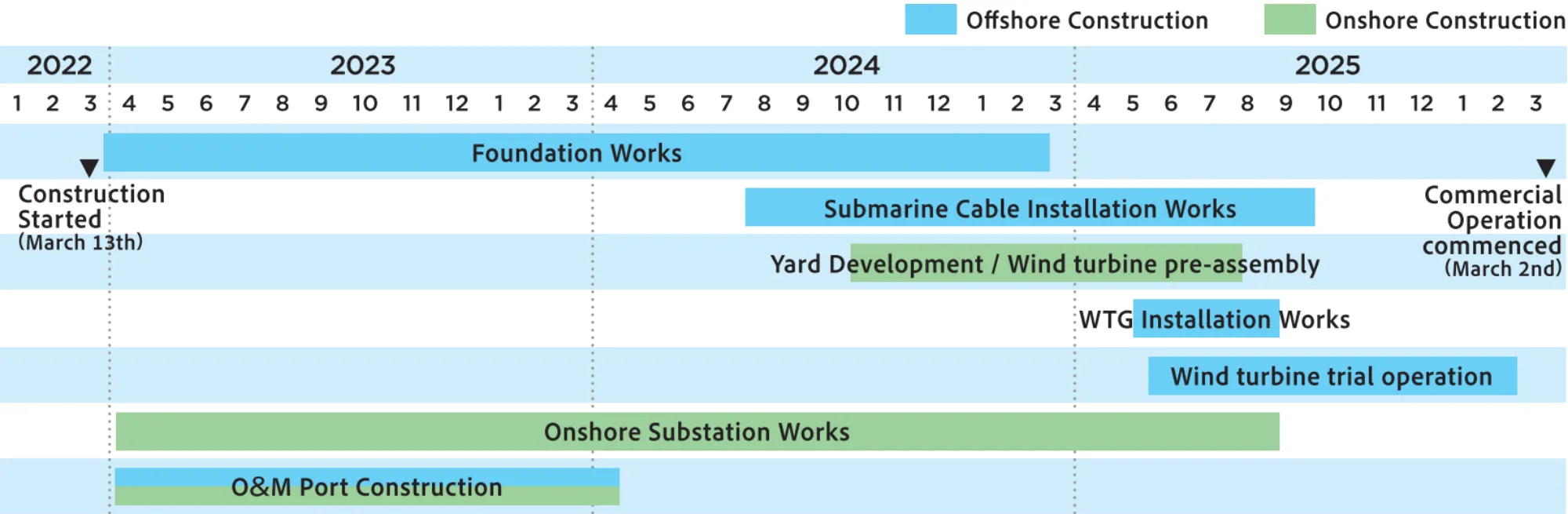
Construction began in March 2023. Offshore construction was carried out in sequence, starting with the installation of wind turbine foundations, followed by submarine cables and then wind turbines. Commercial operation commenced on March 2, 2026.
Onshore substation facilities were also installed to deliver electricity generated by the offshore wind turbines to the power grid. In addition, an O&M base port was developed for berthing CTVs (Crew Transfer Vessels), which are essential for maintenance activities after the start of operations.

Wind Turbine Foundation Construction (Pile Installation)
Foundation piles were installed into the seabed using piling vessels and SEP vessels (self-elevating platform vessels). Three different installation methods were adopted to suit the geological conditions.

Wind Turbine Foundation Construction (Jacket Foundations)
The jackets were lifted by a large floating crane and transported by sea to their installation locations, where they were installed onto the foundation piles that had been placed in advance.

Submarine Cable Installation
The cables connecting the wind turbines to each other and to the onshore electrical facilities were temporarily laid on the seabed while being deployed from a cable-laying vessel. They were then buried beneath the seabed using specialized equipment.

Wind Turbine Installation
Wind turbine components were pre-assembled at the base port, and components for three turbines were loaded onto an SEP vessel. The vessel then sailed to the installation site, where the tower, nacelle, and blades were sequentially installed on the wind turbine foundation using the vessel's crane.

Substation Construction
Electricity generated by the offshore wind turbines is transmitted via submarine cables to the onshore substation, where the voltage is transformed and regulated before the electricity is delivered to the power grid through transmission lines.
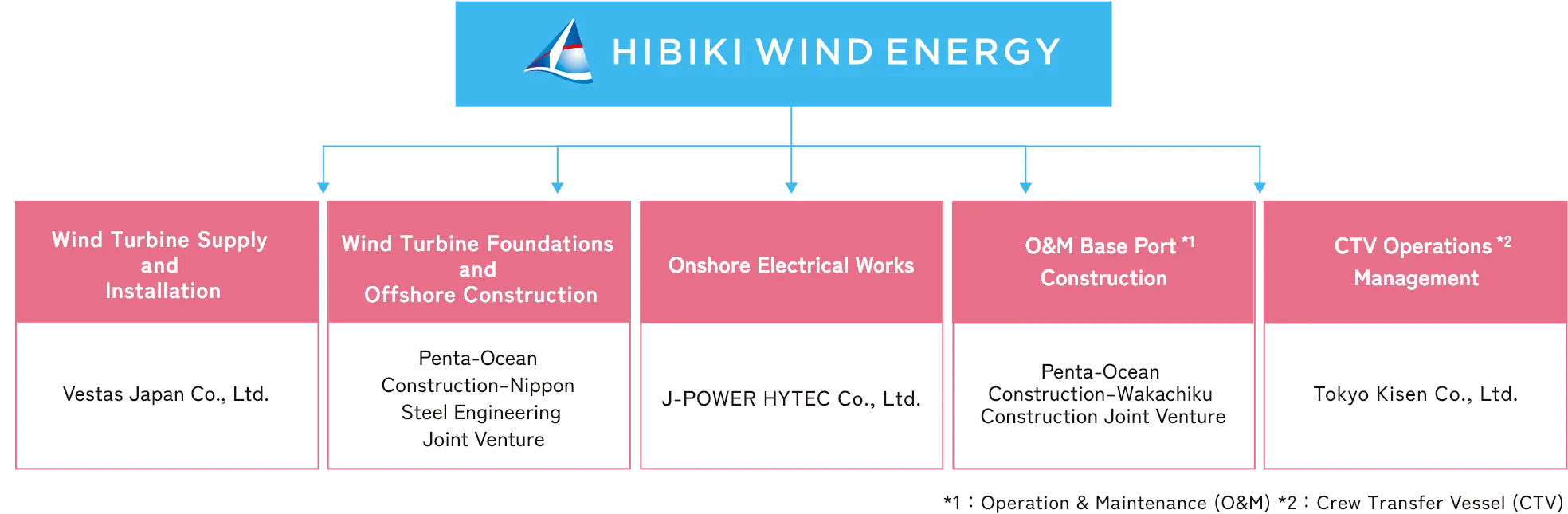
Construction Organization
About Hibiki Wind Energy
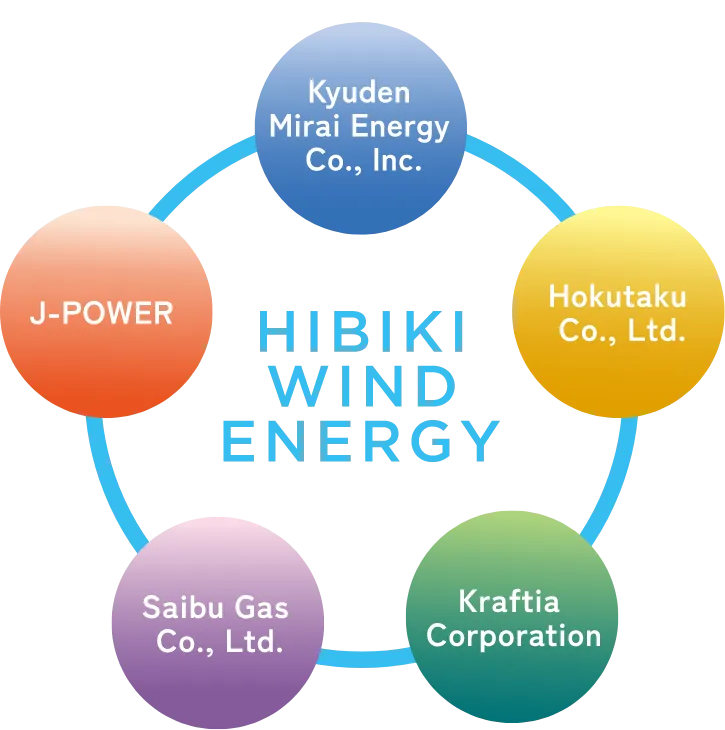
Hibiki Wind Energy Co., Ltd. is a project company formed by five companies: Kyuden Mirai Energy Co., Inc., Electric Power Development Co., Ltd. (J-POWER), Hokutaku Co., Ltd., Saibu Gas Co., Ltd., and CRAFTIA Corporation.
With the goal of creating “An Offshore Wind Farm Growing with the Community,” the company is responsible for the construction, operation, and maintenance of the wind farm.
Shareholding Structure and
Ownership Ratios
Kyuden Mirai Energy Co., Inc.: 30%
Electric Power Development Co., Ltd.
(J-POWER): 40%
Hokutaku Co., Ltd.: 10%
Saibu Gas Co., Ltd.: 10%
KRAFTIA Corporation: 10%